

By Jerrel from Dododots, Dododots Product Team. Last updated: 20 Oct 2026.
Pick the patch by the spot. Plain hydrocolloid patches suit spots with a head or spots that have opened. Microneedle patches are sold for early, under-the-skin bumps but have less evidence, and medicated patches add an ingredient that hasn't been shown to beat a plain patch.
If you're new to patches, start with our pimple patch basics. This post is for picking between types.
What's the difference between hydrocolloid, microneedle and medicated patches?
Hydrocolloid patches are a gel-forming sticker that soaks up fluid from an open spot and covers it. Medicated patches are usually hydrocolloid plus an added ingredient like salicylic acid or tea tree oil. Microneedle patches have tiny spikes on the underside that dissolve into the top layer of skin, according to Maitland Dermatology (Oct 2026).
| Hydrocolloid (plain) | Medicated | Microneedle | |
|---|---|---|---|
| What it is | Gel-forming patch that absorbs fluid and covers the spot | Usually hydrocolloid with an added ingredient | Patch with tiny dissolving spikes, often hyaluronic acid based |
| Typical added ingredients | None | Salicylic acid, benzoyl peroxide, niacinamide, tea tree oil | Varies by brand. Check the pack |
| Spot it's sold for | Spots with a white head, or opened spots | Same as plain | Early, sore bumps with no head |
| Evidence (as of Oct 2026) | Small, mostly brand-funded trials on surface spots | No good study showing it beats plain | Small studies, mostly without a comparison group |
| Irritation risk | Mostly the adhesive | Higher, from the added ingredient | Varies with ingredients. Can sting |
| Typical cost | Lowest | Middle | Highest per patch |
| Best for | Most people, most spots | People who've used that ingredient before without a reaction | Trying on an early bump, if you accept the thin evidence |
Verdict: if you buy one kind, buy plain hydrocolloid. That's also Maitland Dermatology's read (Oct 2026).
Which patch should you use for each pimple stage?
Match the patch to what you see: a spot with a white head or one that's already open suits a plain hydrocolloid patch. A red, sore bump with no head has no fluid at the surface, so a plain patch mostly just covers it. Blackheads and deep cysts aren't a good match for any patch.
| Pimple stage | What it looks like | Patch match | Notes |
|---|---|---|---|
| Early bump | Red, tender, no head | Plain patch to stop picking, or a microneedle patch | Evidence for microneedle patches is thin |
| Whitehead / pustule | Raised with a visible white or yellow centre | Plain hydrocolloid | The type with the most data behind it |
| Opened or popped | Open, weeping a little | Plain hydrocolloid | Clean and dry the area first |
| Drying out | Flat, crusty, closing over | Thin or clear patch, mainly as cover | Little fluid left to absorb |
| Blackheads | Small dark dots, flat | Not a patch job | A cleanser or leave-on product suits these better |
| Cyst or nodule | Deep, large, painful | Not a patch job | See a doctor if these keep coming back |
Do microneedle pimple patches work?
The early evidence is mixed and small. A 2022 study in the Journal of Cosmetic Dermatology had 30 people use dissolving microneedle patches daily for 28 days and reported smaller spots, but it had no comparison group. Maitland Dermatology (Oct 2026) calls the evidence thin and notes several studies were paid for by makers.
A 2023 randomised trial in 35 people tested microneedle patches carrying a prescription steroid. Spots cleared in about 5 days with steroid patches, about 7 with plain microneedles and about 8 with no patch. That's a prescription product, not the kind sold over the counter.
So think of any shop microneedle patch as a "might help a little" product, not a sure thing. If it stings or the skin stays red, stop.
Are medicated pimple patches better than plain ones?
Not that anyone has shown. Maitland Dermatology (Oct 2026) says no good study shows a salicylic acid or tea tree oil patch beats a plain hydrocolloid one. Added ingredients can irritate the skin trapped under the patch, which their clinic sees as a red ring where the patch sat.
If you like an ingredient, their advice is to put it on the skin, let it dry and use a plain patch separately. That way you control how much goes on.
Can you use a pimple patch with salicylic acid, benzoyl peroxide or retinoids?
Yes, just not stacked under the patch. Everyday Health (Jan 2026) quotes Dr. Angela Lamb advising against putting patches over other active products unless your dermatologist says so. A patch seals what's under it, so strong products like retinoids, benzoyl peroxide and salicylic acid can irritate more than usual.
A simple way to fit them together:
- Morning: cleanse, put the patch on clean, dry skin, then sunscreen and makeup around it.
- Evening, spot night: cleanse, put on the patch first, then apply your salicylic acid, benzoyl peroxide or retinoid to the rest of the face, keeping it off the patch.
- Evening, product night: skip the patch on that spot. Use your usual product and let it dry.
- Next day: check the skin. Redness or peeling around the spot means it's time to space things out.
One more rule from the College of Family Physicians of Canada (Jul/Aug 2025): most retinoids other than adapalene shouldn't be layered with benzoyl peroxide, as it can break them down. Ask a pharmacist if you're not sure what you're using.
Can you wear a pimple patch under makeup?
A thin, clear or skin-tone patch works best under makeup. Put it on clean, dry skin before any makeup, then pat foundation or concealer over it gently instead of rubbing. Thick or textured patches, including many microneedle ones, show more, so swap to a thin one and replace it if the edges lift.
Skip primers and serums on the patch spot itself, since patches don't stick over them. Remove makeup gently around the patch at night, then swap in a fresh one. Here's how long to leave a pimple patch on.
Where do Dododots fit in?
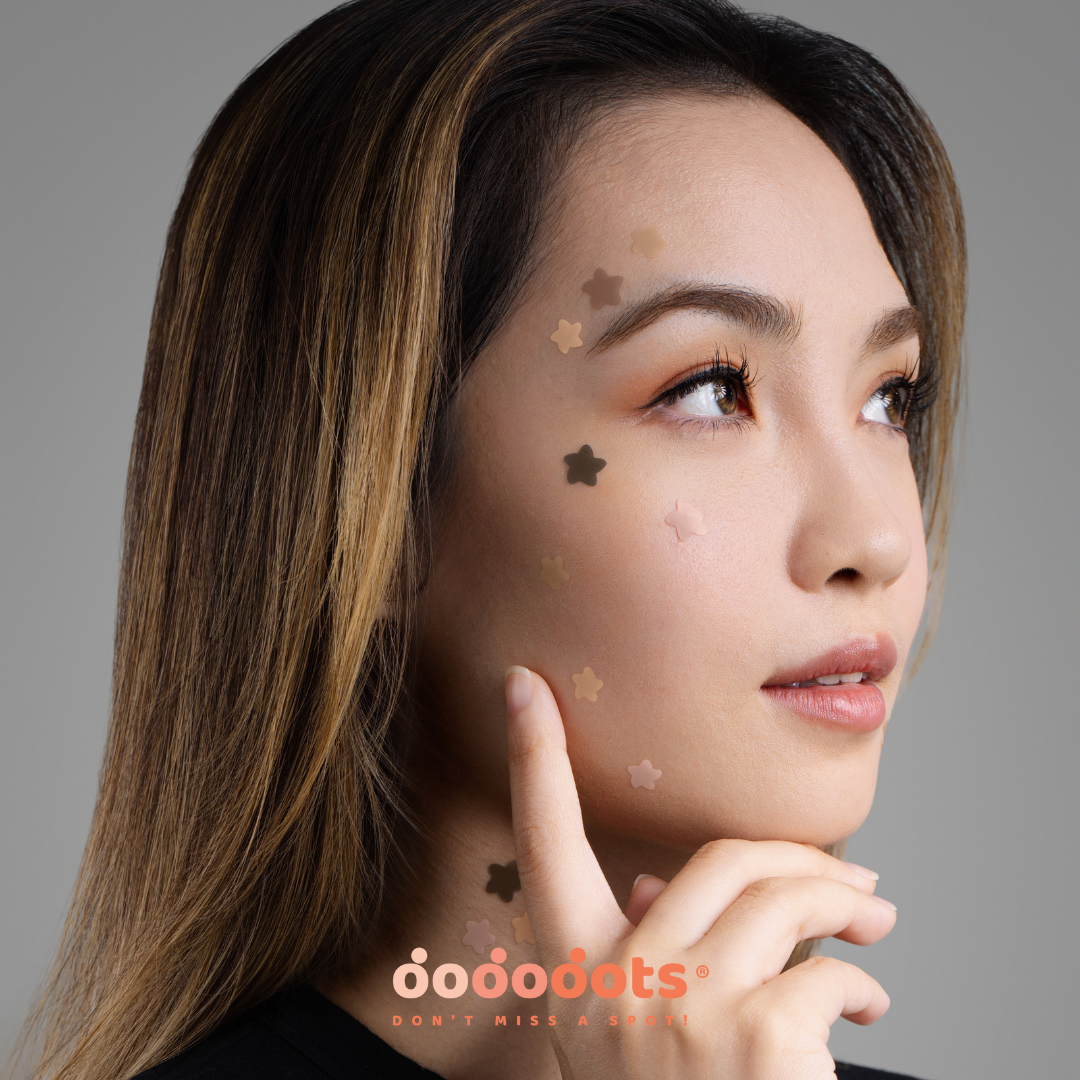
Dododots makes hydrocolloid design and skin-tone patches for covering a spot and keeping fingers off it. Most of our range is for the "white head or opened spot" stage, plus daytime wear where you either want to blend in or show off. Packs and prices below are from dododots.com, checked on 20 Oct 2026.
| Use | Pack | What's listed | Price |
|---|---|---|---|
| Under makeup | Dodoskin (with Tea Tree Oil) | 36 star patches, two sizes, 5 skin-tone shades | RM 18 |
| Clear daytime cover | Dodobear (with Tea Tree Oil) | 36 clear bear patches, two sizes | RM 18 |
| No tea tree oil | Butterflies | 20 patches (12 x 12 mm) | RM 10.50 |
| Trying a few designs | 8 in 1 Discovery Set | 8 patches | RM 10 |
Some of our packs list tea tree oil and some don't, so check each page. If your skin is sensitive or you're already using strong products, start with one patch on a small area. Browse the full range or see where to buy.
Frequently asked questions
Hydrocolloid vs microneedle pimple patch: which is better?
It depends on the spot. Plain hydrocolloid is the better-studied choice for a spot with a head or one that has opened, because it can take up surface fluid and cover it.
Microneedle patches are sold for early, deep bumps with no head. The studies so far are small and mostly lack a comparison group, so expect a maybe, not a promise. If you're buying one kind, plain hydrocolloid is the safer bet.
Can I use a microneedle patch on a whitehead?
You can, but there's little reason to. A whitehead already has fluid at the surface, which is what a plain hydrocolloid patch is made to absorb.
Microneedle patches usually cost more per patch and are marketed for early bumps. On a whitehead, a plain patch is cheaper, and pressing spikes into a spot that's about to open can feel sore. Stick with plain for this stage.
Do medicated patches cause irritation?
They can. Maitland Dermatology (Oct 2026) says added ingredients can irritate the skin trapped under the patch and often see it as a red ring where the patch sat.
Salicylic acid, benzoyl peroxide and tea tree oil are the usual suspects. If you get redness, itching or stinging, switch to a plain patch and use any spot product separately, letting it dry first.
Should I put salicylic acid under a pimple patch?
It's best not to unless your dermatologist tells you to. The patch seals the area, which can make an acid sting or irritate more than it would on open skin.
A simpler routine is to use the acid on nights you don't patch that spot, or on the rest of your face around the patch. That keeps the patch sticking well too.
Can I use retinol and pimple patches together?
Yes, as long as you don't put the patch over the retinol. Retinoids can make skin dry and sensitive, and sealing them under a patch adds to that.
Put the patch on clean skin first, then apply retinol to the rest of your face, avoiding the patch. If the skin around the spot peels or stings, take a night off from one or the other.
Are microneedle patches safe?
Studies so far report few side effects, but they're small, so the picture isn't complete. Some people feel a slight sting when the patch goes on.
Don't use them on broken, irritated or infected skin, near the eyes or over a popped spot. Stop if you get redness that doesn't settle. If you're pregnant or using prescription acne products, check the ingredients with a pharmacist first.
Quick recap
- Plain hydrocolloid suits spots with a head or opened spots. It has the most data.
- Microneedle patches are sold for early bumps. Evidence is small and mostly brand-linked.
- Medicated patches haven't been shown to beat plain ones and can irritate.
- Don't put acids, benzoyl peroxide or retinoids under a patch. Use them around it or on other nights.
- Thin, clear or skin-tone patches sit best under makeup.
Sources
- Maitland Dermatology (Danielle Perna, MD), "Pimple patches: what they can do, what they cannot, and which kind to buy", 12 Oct 2026. https://maitlandderm.com/blog/pimple-patches-what-works/
- Everyday Health, "When to Not Use a Pimple Patch, and 5 Other Mistakes to Avoid", 7 Jan 2026. https://www.everydayhealth.com/skin-care/pimple-patch-mistakes-to-avoid/
- Journal of Cosmetic Dermatology, "Acne and its post-inflammatory hyperpigmentation treatment by applying anti-acne dissolving microneedle patches", 5 Sep 2022. https://doi.org/10.1111/jocd.15352
- PMC (Clinical, Cosmetic and Investigational Dermatology), "Efficacy and Safety of Detachable Microneedle Patch Containing Triamcinolone Acetonide in the Treatment of Inflammatory Acne", 2023 (PMID 37303985). https://pmc.ncbi.nlm.nih.gov/articles/PMC10252967/
- Canadian Family Physician, "Update to acne vulgaris treatment for Canadian practice", Jul/Aug 2025. https://www.cfp.ca/content/71/7-8/455
- Cleveland Clinic, "How Do Pimple Patches Work?", 28 Nov 2025. https://health.clevelandclinic.org/how-do-pimple-patches-work


Leave a comment
This site is protected by hCaptcha and the hCaptcha Privacy Policy and Terms of Service apply.